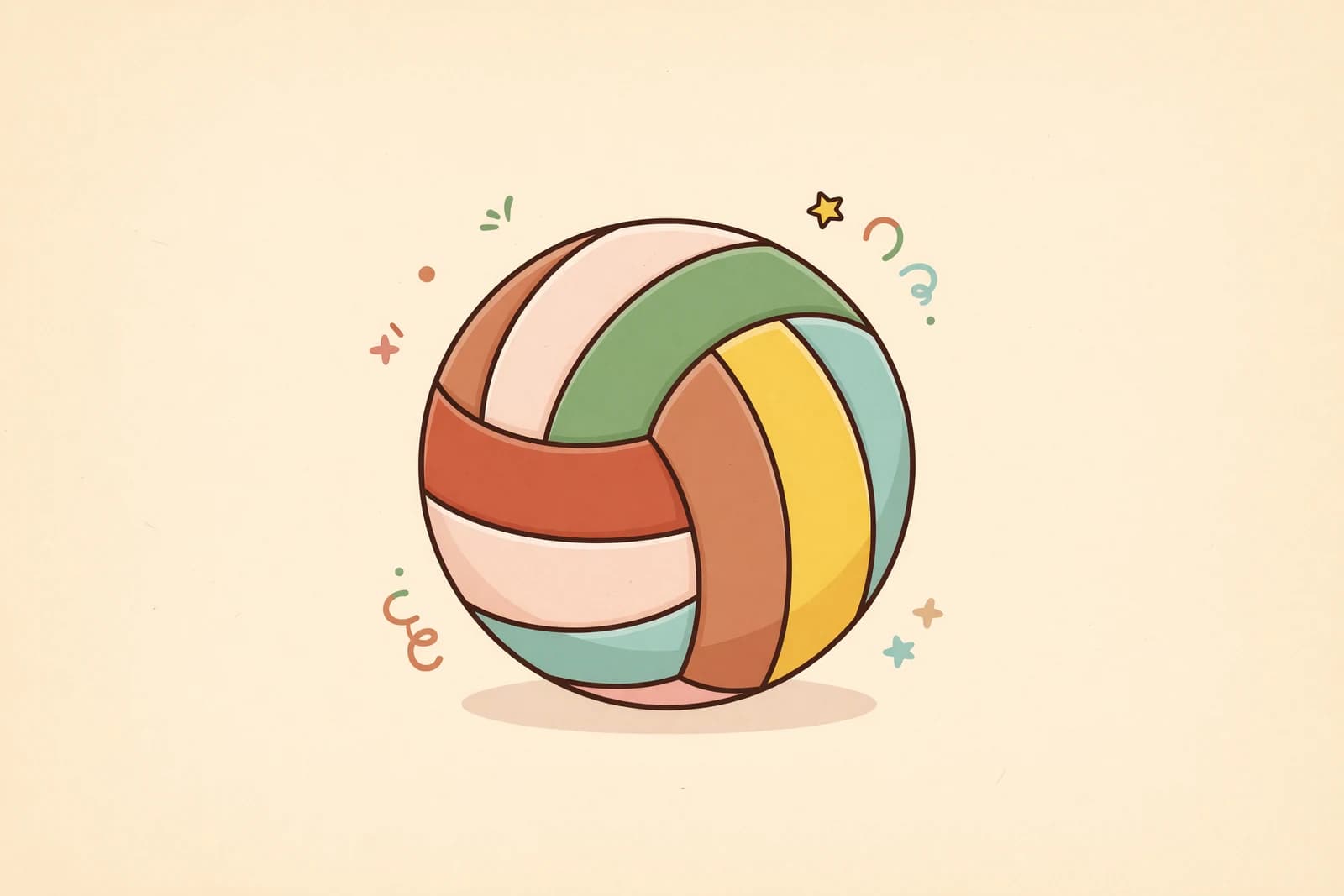
Learn how to draw a volleyball the easy way. A simple, foundation-first volleyball drawing for beginners with curved panel lines and shading to look 3D.
A volleyball looks complicated with all its curved panels, but it's really just a circle with a handful of smile-shaped lines drawn in the right places. In this guide you'll learn how to draw a volleyball step by step, starting from a simple circle and building up the panels until you have a clean, game-ready ball. This is an easy volleyball drawing that anyone can finish, even if you've never drawn a sports ball before.
We'll work foundation-first: a light circle, then guide lines, then the curved panel seams, and finally a little shading so the ball looks round and 3D. Keep your early lines feather-light so they're easy to erase. Grab a pencil and let's begin.
What you'll need
- A pencil (any pencil works)
- An eraser
- Plain paper
- Optional: a round lid to trace a neat circle, a black pen or marker for outlining, plus crayons or markers to color
How to draw a volleyball step by step
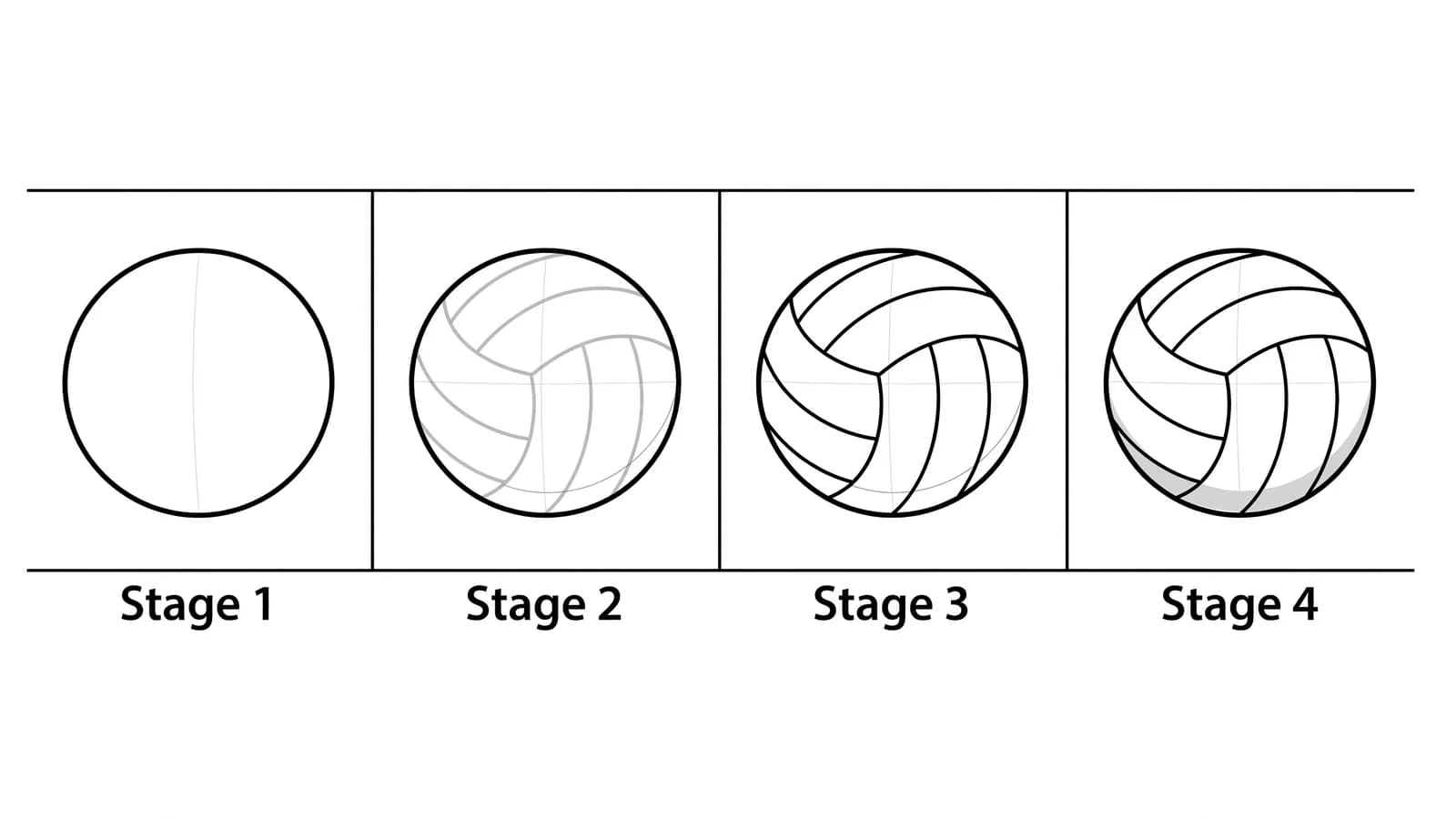
This is the way art teachers block in a volleyball: start with the round shape, add light straight guides, then turn those guides into the curved panel seams. The teacher Kathy Barbro begins her kid-friendly lesson simply: draw or trace a circle, and build everything on top of that one shape. Take it one curve at a time.
Step 1: Draw a light circle
Press lightly and draw a circle, or trace a round lid for a neat one. This is the whole ball. Keep it soft and gray for now, since you'll be drawing guide lines through it in a moment.
Step 2: Add light straight guide lines
From near the center of the circle, lightly draw a few straight lines fanning outward toward the edge. Teacher Shelly at Welcome To Nana's has students lightly draw three lines out from the center of the circle first. These straight lines give you starting and ending points for the curved panels, so they don't wander.
Step 3: Draw the first curved panels
Turn your straight guides into gentle curves. Draw three curved lines that swoop from one side of the ball, bend through the middle area, and reach the other side, following where your guide lines point. Each curve should look like a soft smile or frown that hugs the round shape. Use the straight lines to keep the starts and ends even.
Step 4: Add the smaller panel lines
A volleyball has groups of panels, so add the shorter curved lines that branch off the main seams. Place a couple of small curves between the big ones to split the surface into the classic six-section look. Keep them curved, never straight, so they wrap around the ball.
Step 5: Erase the straight guides
Now gently erase the straight guide lines from Step 2, leaving only the curved panel seams and the outer circle. Shelly gives this same advice: use the straight lines to place your curves, then erase the straight lines. Suddenly it reads as a real volleyball.
Step 6: Outline the ball
Go over the outer circle and the panel seams with a firmer pencil stroke or a black pen. Kathy Barbro finishes her tutorial the same way: trace with a marker and then color. Clean, confident lines make the ball look finished.
Step 7: Shade it to look 3D
Pick a light source, like the upper-right, and lightly shade the opposite edge. Shelly suggests you use the side of the pencil lead to shade the edge of the ball away from the light, then add a few contour lines on the shaded side to help it look rounded. Leave a small bright spot on the light side as a highlight, and your flat circle becomes a solid, round ball.
What artists recommend (and common mistakes)
A volleyball lives or dies on its panel lines and a touch of shading. Here's what teachers stress:
- Start with one clean circle and build on it. Art teacher Kathy Barbro begins every panel from that single traced or drawn circle. A neat circle keeps the whole ball from looking lumpy.
- Use light straight guides, then erase them. Teacher Shelly at Welcome To Nana's has students draw straight lines first to mark where each curved seam starts and ends, then remove them once the real curves are placed. This keeps the panels even instead of crooked.
- The most common mistake is leaving the ball flat. Beginners often draw the circle and seams and stop, so it looks like a circle with lines, not a sphere. Shelly fixes this by having students draw a small sun for the light source and then shade the edge of the ball away from the light, darkening one side and softening inward. Skip the shading and the ball stays flat.
Fun variations to try
- A bouncing volleyball: Add a few short curved motion lines and a little dust puff under it.
- A beach volleyball: Color the panels in bright blue, yellow, and white stripes instead of plain white.
- A volleyball and net: Draw a simple net behind the ball for a full court scene.
- A spiking hand: Add a cartoon hand above the ball, mid-spike, for some action.
- A glossy ball: Make the highlight bigger and sharper so the volleyball looks shiny and new.
Frequently asked questions
How do you draw a volleyball easily? Draw or trace a circle, add a few light straight guide lines from the center, then turn them into three curved panel seams with a couple of smaller curves between. Erase the straight guides, outline the curves, and add light shading on one side. That's a complete, easy volleyball drawing.
How many lines does a volleyball have? A classic volleyball reads as six panel sections made from curved seams. You can draw it simply with three main curved lines plus a few shorter branch lines, which is plenty to make it instantly recognizable.
Why doesn't my volleyball look round? The panel lines are probably too straight, or there's no shading. Curve every seam so it follows the ball's shape, and add soft shading on the side away from the light to give it round, 3D volume.
Keep drawing and coloring
Now that you can draw a volleyball, try its court cousins. The same circle-and-shading method powers a how to draw a basketball, and if you want to master the round, 3D look on its own, our how to draw a ball guide breaks down shading a sphere step by step. Want more quick wins? Browse our easy things to draw or print our free coloring pages and color a few in. You've got this.