Learn how to draw fire and flames the easy way, from a simple shape to wavy, glowing edges and color. A beginner-friendly, step-by-step fire drawing guide.
Fire looks tricky because it is always moving, but how to draw fire comes down to a few wavy shapes stacked together. Once you block in a simple base and turn the straight lines into flickering arcs, you've got a flame. In this guide you'll learn how to draw fire step by step, the easy way, building from one basic shape up to glowing flames you can color hot or cool. No experience needed, so grab a pencil and let's light it up.
Keep your first lines light. Fire has no hard outline, so soft, loose strokes work best.
What you'll need
- A pencil and an eraser
- Plain paper
- Optional: yellow, orange, and red crayons, markers, or colored pencils for color
How to draw fire step by step
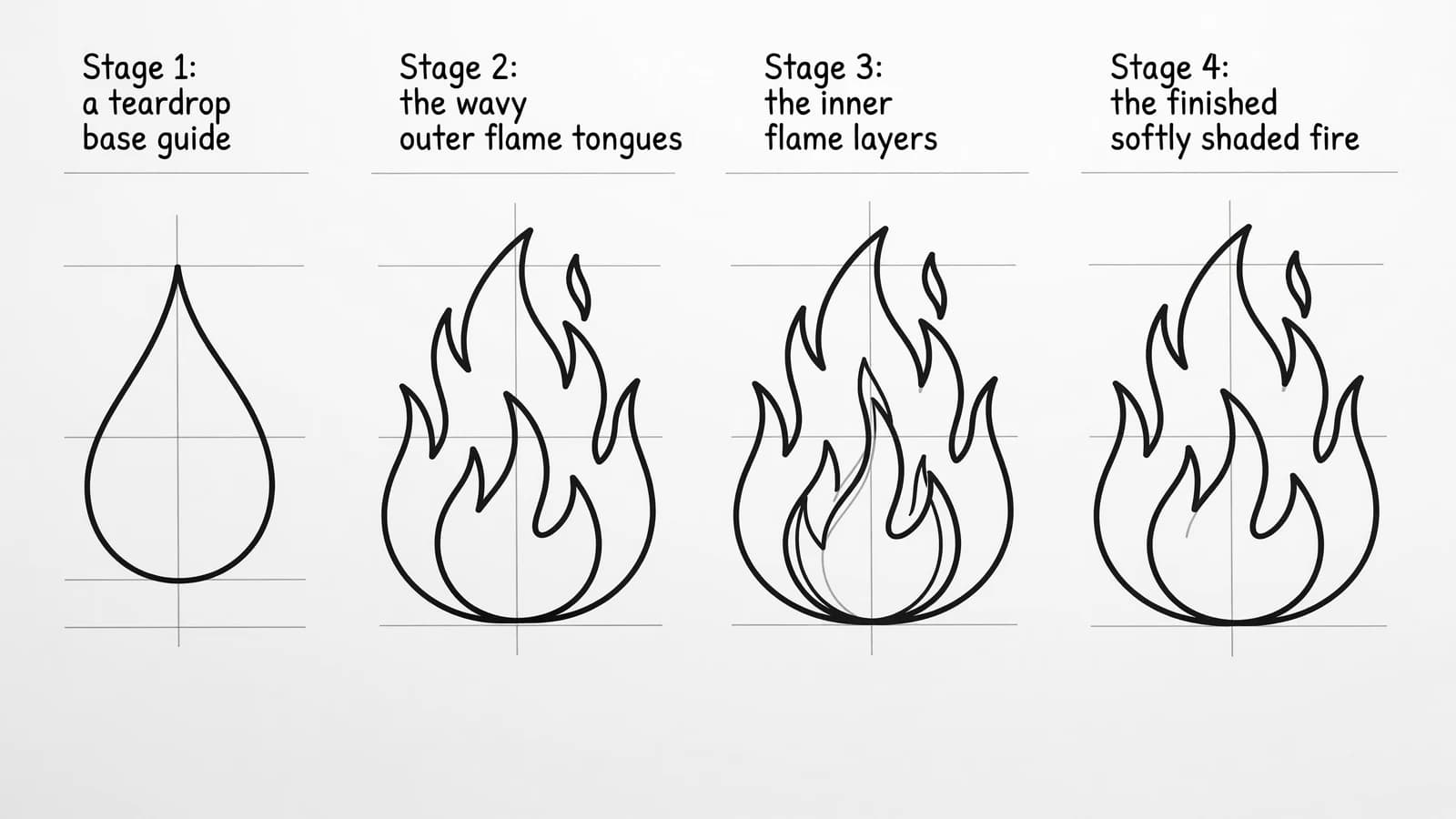
The key to believable flames is to start with a tidy shape and then mess it up on purpose. Grabie's tutorial begins with a circle and an upward triangle as a construction base, then says to erase those guidelines and turn the straight lines into random arcs, because fire is "constantly changing" (Grabie). We'll follow that same path, ending with color built light to dark.
Step 1: Block in a base shape
Lightly draw a circle near the bottom for the base of the fire, then a tall triangle pointing up from it. Think of a teardrop or a candle flame. This simple guide sets how tall and wide your fire will be. Keep it faint.
Step 2: Turn straight lines into wavy arcs
Now redraw the sides of that triangle as soft, curving arcs instead of straight lines. Make them flicker in and out. Grabie's lesson stresses turning rigid lines into random arcs so the flame feels alive (Grabie). No two edges should match.
Step 3: Add flame tongues
Split the top of your flame into two or three pointed tongues that lick upward and curl slightly to one side, as if a breeze is pushing them. Different heights look the most natural. Erase your triangle and circle guides now.
Step 4: Draw inner flames
Inside the big flame, draw one or two smaller flame shapes that follow the same wavy, upward motion. These inner shapes become the brighter, hotter core when you add color. Keep their points aiming up like the outer flame.
Step 5: Add a base and embers
At the bottom, add a few short curved lines for logs, a candle, or coals. Sprinkle a few tiny dots and short streaks rising off the flame for sparks and embers. These little touches sell the idea that the fire is burning something.
Step 6: Outline and color light to dark
Trace your final flame lines with a firmer stroke. Then color from light to dark: start with yellow in the hot inner core, add orange around it, and finish with red on the outer edges. Art for Kids MAT recommends starting with yellow, layering darker orange and red, and keeping every stroke moving upward to match the flame's motion (Art for Kids MAT).
What artists recommend (and common mistakes)
- Start simple, then break it up. Block in a basic teardrop or triangle first, then convert the straight lines into wavy arcs (Grabie).
- Don't draw stiff, geometric flames. The most common mistake is leaving fire too rigid. Real fire has no fixed shape, so replace straight outlines with random, flickering arcs (Grabie).
- Color light to dark. Yellow in the hot core, orange around it, red at the edges. Keep strokes moving upward like the flame (Art for Kids MAT).
- Vary the tongues. Same-height, same-size flame tips look fake. Mix tall and short, and let them lean the same way.
Fun variations to try
- Campfire: Stack a few crossed logs at the base and add a cluster of small flames with rising sparks.
- Blue fire: Color the same flame with blue and white in the core for a magic or gas-flame look.
- Single candle flame: One small teardrop flame with a soft glow ring around it, perfect for a calm scene.
- Dragon's breath: Stretch the flames into a long blast for a fire-breathing creature.
Frequently asked questions
How do you draw fire for beginners? Start with a simple teardrop or triangle shape, then turn the straight sides into soft wavy arcs. Add a few pointed tongues at the top, draw a smaller flame inside, and color from yellow in the center out to red. Building from one simple shape makes an easy fire drawing work.
Why does my fire drawing look stiff? Most likely your flame lines are too straight and even. Fire has no fixed shape, so swap rigid outlines for irregular, flickering arcs and mix up the height of the flame tongues to make it feel like it's moving.
What colors should I use for fire? Layer light to dark: yellow for the hottest inner core, orange in the middle, and red on the outer edges. Add a touch of white for the brightest spot. Cool versions can use blue and white instead.
Keep drawing and coloring
Fire pairs perfectly with the things it powers. Try how to draw a volcano to put your flames in a big eruption, then add a fire-breather with how to draw a dragon. Browse cool things to draw for more ideas, then print our free coloring pages and color in some warm, glowing scenes. You've got this.