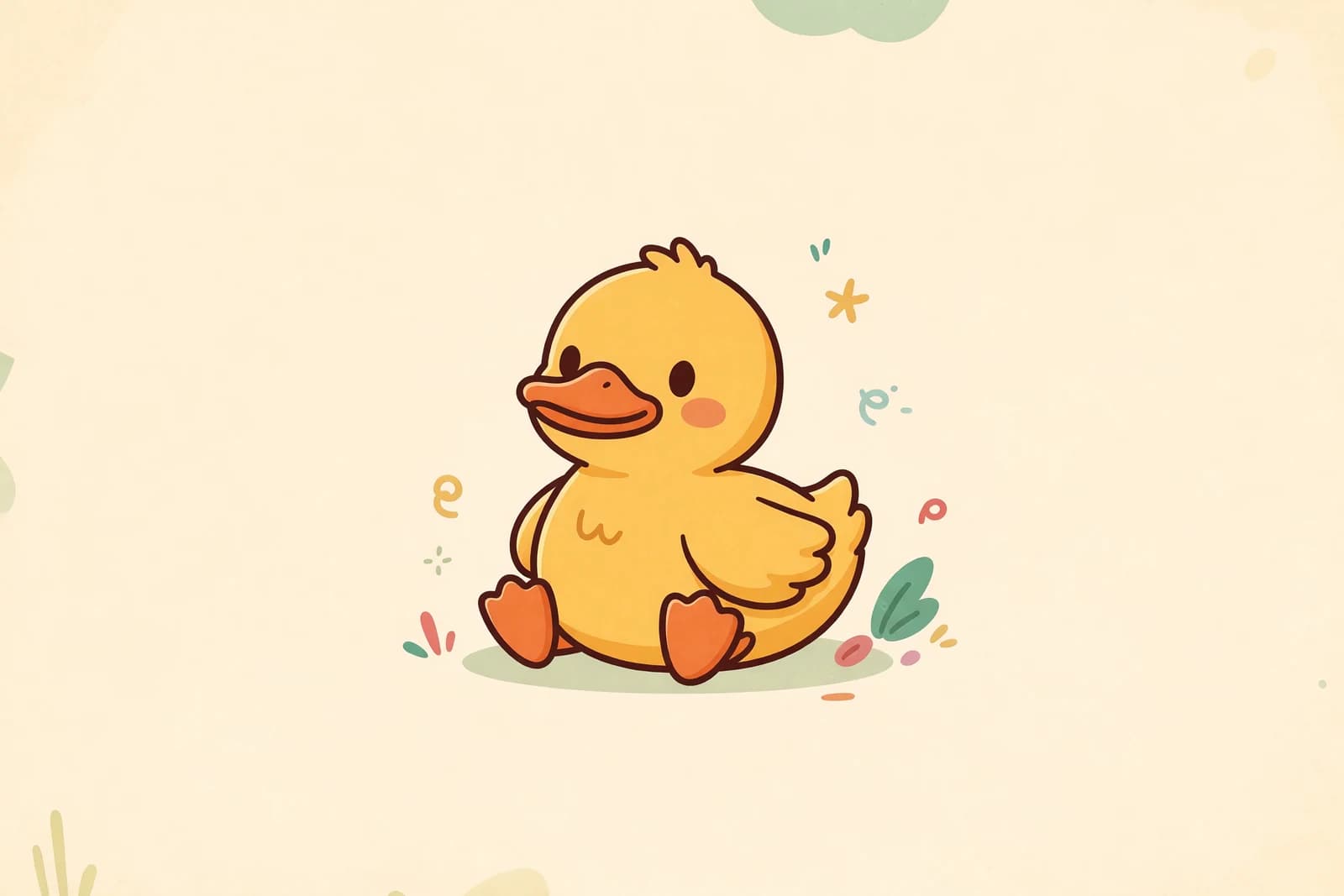
Learn how to draw a duck the easy way, from two simple circles to a curved neck, beak, and tail. A cute, beginner-friendly step-by-step guide, no experience needed.
A duck is a great drawing for beginners, because it starts as just two round shapes, one for the body and one for the head, joined by a curvy neck. In this guide you'll learn how to draw a duck step by step, from those simple circles to the rounded beak, the perky tail, and a little wing. No experience needed, and it works for a cute cartoon duck or a more realistic one.
We'll draw a duck floating in side view, the easiest way to show off its shape. Sketch lightly so you can adjust before you commit, then darken your final lines. Let's begin.
What you'll need
- A pencil and an eraser
- Plain paper
- Optional: a black pen for outlining, plus yellow or brown crayons or markers
How to draw a duck step by step
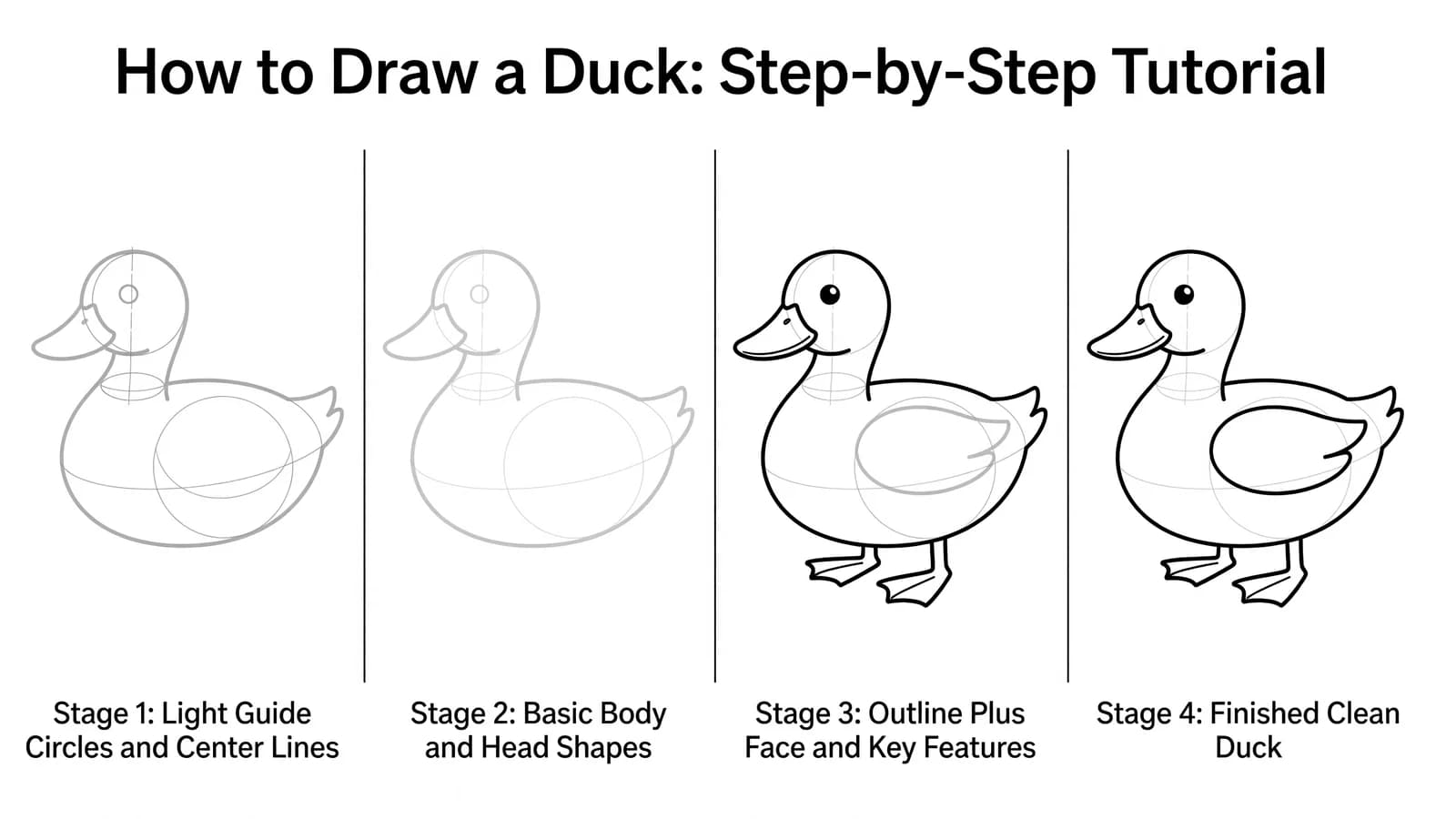
Step 1: Draw the body and head
Start with a light oval for the body and a smaller circle above and in front of it for the head. Ranger Dave's lesson for the U.S. Fish & Wildlife Service begins a duck with a roundish oval body and a circle head, refining the outline only after the proportions feel right. Keep both shapes light.
Step 2: Connect the neck with curves
Join the head to the body with two short curved lines for the neck. Think in curves, not straight lines: the mallard duck art lesson uses curved strokes for the head, neck, and back to capture the duck's rounded forms. A gentle S-curve from the back of the head into the body gives a natural pose.
Step 3: Add the beak
On the front of the head, draw the beak as a flat, rounded shape, wider at the front than a chicken's pointed beak. Add a small line across it to separate the top and bottom. A soft curved beak fits the rounded duck better than a stiff triangle.
Step 4: Draw the tail and back
At the back of the body, add a small pointed tail that flips up, like a little wedge. Then smooth the curve of the back so it flows from the neck to the tail. The perky upturned tail is a signature duck detail.
Step 5: Add the wing and eye
Draw a curved teardrop shape on the side of the body for the folded wing, with a few lines inside for feathers. Add a small round eye on the head, near the top of the beak. Keep the eye simple, just a dot with a tiny white highlight for a friendly look.
Step 6: Outline and erase guide lines
Trace the lines you want to keep with a firmer stroke or a black pen, then erase the leftover guide marks. Don't press hard and ink the outline straight away. Check the whole silhouette first, fix a too-small head or misplaced beak, and only then darken the final lines.
Step 7: Color your duck
Color a classic yellow duckling, a white farm duck, or a green-headed mallard drake. Leave a soft highlight on the belly, color the beak orange, and add ripples of blue water underneath if your duck is swimming.
What artists recommend (and common mistakes)
- Build from simple shapes. Start with one oval and one circle, then refine. This keeps the body and head in proportion before you add the neck, beak, and tail.
- Think in curves. A duck is all rounded forms. Curved lines for the beak, head, and back read far more like a duck than stiff straight edges.
- Sketch light, then darken. The biggest beginner mistake is pressing hard and inking the final outline right away, so a too-small head or misplaced beak is hard to fix. Draw loose construction shapes first, adjust, then commit.
- Keep the beak flat and wide. A duck beak is broad and rounded, not a sharp point. That single detail tells it apart from other birds.
Fun variations to try
- A cute duck: Make the head big, the eyes large, and the body extra round and chubby for a baby duckling.
- A rubber duck: Smooth the body into one round blob, flatten the tail, and color it bright yellow with a small orange beak.
- A duckling: Shrink the whole shape, add fluffy edges, and draw a row of them following a parent.
- A swimming duck: Hide the legs under the water and add curved ripple lines around the body.
Frequently asked questions
How do you draw a duck for beginners? Start with an oval for the body and a circle for the head, connect them with a curved neck, then add a flat beak, an upturned tail, a wing, and an eye. Two simple shapes keep the whole duck in proportion.
How do you draw a cute duck? Make the head big compared to the body, give it a large round eye with a highlight, and keep everything soft and chubby. Big eyes and round forms are what make it look sweet.
How do you draw a rubber duck? Use one round body, a smooth flat tail, and a small rounded beak, then color it bright yellow. A rubber duck is simpler than a real one because the shapes are extra smooth and bubbly.
Keep drawing and coloring
Once your duck is floating, give it some pond company. Try how to draw a frog for the lily pads or how to draw a penguin for another round-bodied bird, browse more easy drawing ideas, then print our free animal coloring pages to color a whole flock of your own.